Guiding Digital Childhoods
Guiding Digital Childhoods at Widmer End Community Combined School & Pre-School
Guiding Digital Childhoods have produced the following information, for this brilliant initiative. It has been developed as a Chiltern Area Partnership (CAP)-wide commitment to help families build healthy, balanced digital habits; delaying smartphones and social media, keeping school time phone-free, and creating more space for play, friendship and independence.
Real Life First | Delay is OK | Growing Up Offline

What is Guiding Digital Childhoods?
Our Aim
Support children’s healthy development and digital well-being through shared family principles and simple school commitments, developed across the local Chiltern Area Partnership (CAP).
Our Four Family Principles (CAP-wide)
📵 Delay smartphones to at least Year 9
🚫 Delay social media to at least 16
🏫 Phone-free school day
🌳 More independence, free play and real-world responsibility.
Our School Commitments (CAP-wide)
- Phone-free school day
- Teach digital safety and literacy
- Regular support for parents
- Staff model healthy tech use
Why This Matters
What Families Told Us
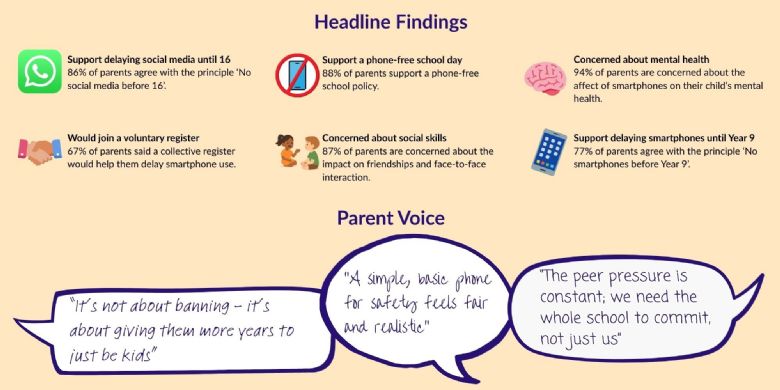
Parents across CAP highlighted peer pressure, safety/transport, and the need for a united approach. Many asked for a simple 'dumb phone' option before Year 9 and practical alternatives for staying in touch.
Development First
We are focused on childhood: routines, sleep, attention, in‑person friendship, and play. Our guidance complements KCSiE and DfE Online Safety Guidance, and is informed by The Anxious Generation, by Jonathan Haidt.
It also aligns with the national Smartphone‑Free Childhood campaign, reflecting its goals in a more locally focused way through CAP collaboration.
Community Action
Collective Action reduces pressure on any one family as we are in it together. The ‘It’s only me’ argument becomes irrelevant.
The voluntary pledge helps parents move together at a sustainable pace.
Survey Highlights: What Our Families Told Us
In Autumn 2024, we surveyed parents across Chiltern Area Partnership schools to inform a shared, community-led approach to smartphones and social media. We received 737 responses, revealing the following headline findings:
Voluntary Family Pledge
Make your family’s commitment to delay smartphones (to Year 9), delay social media (to age 16), keep school time phone-free, and build more real-world independence, at a pace that suits your child.
How It Works
- Optional and non-judgemental
- Anonymous register (aggregate totals only)
- Change or withdraw at any time
Current Widmer End Participation
We have had KS2 workshops brought to us from Papaya, who 'help families thrive in the digital age'.
Taking it Further: Parent-to-Parent Support
In addition to this local CAP pledge, many families also choose to engage with Smartphone Free Childhood, a national, parent-led movement that aligns closely with our work and has endorsed the Guiding Digital Childhoods project.
Smartphone Free Childhood supports parents to:
- Delay smartphones until age 14
- Delay social media until age 16
- Reduce social pressure by acting together
- Connect with other parents locally and nationally
Signing their parent pact is optional, anonymous and takes two minutes. It also sends a powerful message to policymakers that this is something families genuinely care about.
👉 Sign the Smartphone Free Childhood Parent Pact HERE.
👉 Join parent-to-parent WhatsApp support (by region and school) HERE.
Whether or not you sign the pact, we recommend exploring their resources and community support.
Parent/Carer & Pupil Resources
Frequently Asked Questions
How can I keep my child safe on the journey to and from school without a smartphone?
Use a basic call/text phone, pre-agreed routes and contingencies, and set clear check-in points. Many families also use walking buddies or lift shares.
What about homework and apps?
We are reviewing homework expectations to avoid unnecessary reliance on smartphone-only apps. Laptops and desktops remain the preferred tools for online learning.
Will my child be left out if others have smartphones?
That’s why we’re taking a collective approach across CAP - to reduce social pressure and keep choices fair.